Discover the extraordinary life of the common swift, the bird that lives on the wing. A complete guide to its nests, the threats it faces, and how we can protect this remarkable urban ally.
If you’ve ever felt short of air, or like you need to escape your own routine, you need to know the swift’s story. I’m fascinated every time I think about them. Picture living, sleeping, eating, and even mating without touching solid ground for a single second. Sounds like science fiction, doesn’t it? That’s the reality of our most tireless neighbor.
Spain is their home through the brightest months of the year, and understanding their situation means understanding the health of our cities. My aim today isn’t just for you to learn about a bird. It’s for you to feel that wild charge they carry under those black wings.
Note: this article contains affiliate links. If you buy through them, you’re helping keep this blog running and supporting the work we do here. Thank you for your trust!
The common swift: far more than a silhouette in the air
When I talk about the swift (Apus apus), I notice a lot of people mix it up with the swallow or the house martin. Believe me, though, once you learn to tell them apart, the swift becomes your favorite. It’s a creature designed by and for the sky. Its legs are so short they barely serve for clinging to crevices. Its scientific name, Apus, means exactly that: footless.
A perfect piece of aerodynamics
The first thing that grabs you is the crossbow shape. The wings are long, narrow, and swept back, which lets it hit dizzying speeds. I’ve read that they can top 100 kilometers an hour, over 60 miles an hour, in level flight. Isn’t that astonishing? While we sit around complaining about traffic, they cross our avenues like race cars.
The plumage is dark brown, almost black, broken only by a small pale patch at the throat that’s hard to spot without a well-trained eye or a decent pair of binoculars (I use these, though whatever you already own will do). What really gives them away is the scream. That sharp, metallic, relentless shriek that fills the evenings in our cities. For me, that sound is the pulse of summer.
A life spent permanently airborne
Here’s the fact that always makes people stop and stare at me: a swift can spend up to ten months straight in the air without landing once. Ten months.
How do they manage it? It’s a perfect fusion of biology and physics. They eat insects caught mid-flight, what’s known as aerial plankton. They drink by skimming the surface of ponds and rivers with their beaks open. Most incredible of all, they sleep while flying.
Science has found that they shut down one half of the brain while the other half keeps piloting. At dusk they climb to two or three thousand meters, let the currents carry them, and rest in that limbo between sky and earth. It makes me think about our own need to stay attached to something solid, while they find their balance in empty air.
The life cycle: thousands of miles on pure instinct
The energy driving a swift is ancient. They don’t follow maps, they follow the pulse of the earth. In Spain we usually see them arrive between late March and mid-April, depending on whether you’re in the south or the north.
The return from sub-Saharan Africa
Every year these birds make an epic migration. They spend our winter in the equatorial and southern regions of Africa. Crossing the Sahara is a challenge any human would call impossible, and they do it with a matter-of-factness that’s staggering.
When they come back to us, they come with one clear purpose: keeping the species going. This is where their lives run straight into ours, because to breed, they need our buildings.
Choosing a nest: unbreakable loyalty
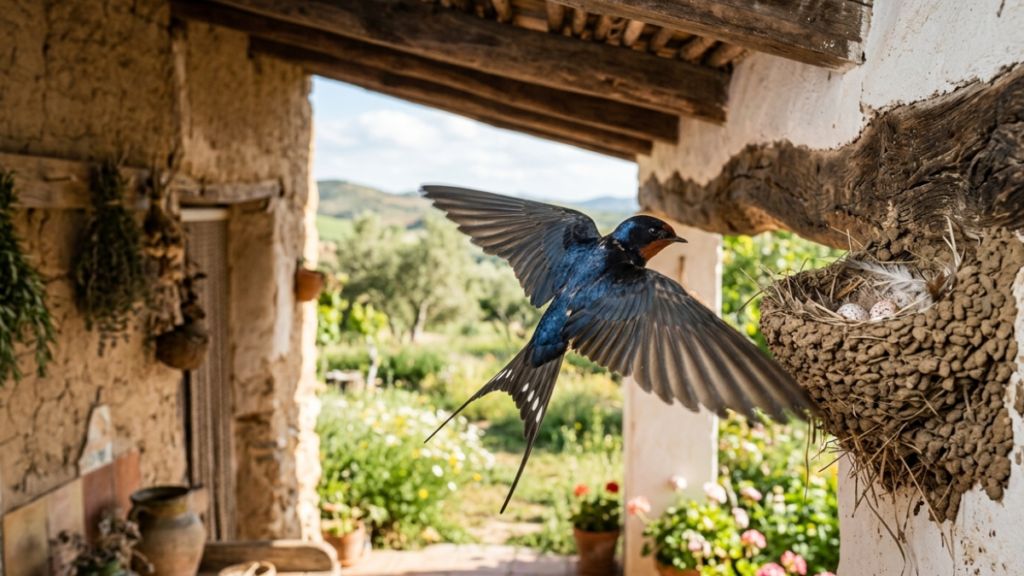
Unlike birds that build visible mud nests, like swallows, the swift is a master of concealment. It looks for deep cavities in walls, spaces under roof tiles, the putlog holes in old fortifications, cracks in old buildings.
What moves me most is their faithfulness. A swift usually returns to the same nest year after year, for its whole life, which can run to ten or twelve years. If that cavity has been sealed during a renovation, the bird can spend days trying to get in, throwing itself against the wall, frantic because its home is gone. It breaks my heart, and it’s exactly why I think we have to speak up.
Courtship and laying
Mating happens in the air as well, or inside the nest. They usually lay two or three white eggs. The curious part is that swift chicks are genuine survivors. If the weather turns and the parents can’t find enough insects, the young drop into a state of torpor, lowering their body temperature and their metabolism to hold out for days without food. It’s an incredible adaptation to the uncertainty of the sky.
A silent ally against pests
We don’t always appreciate our winged neighbors enough. Did you know a single swift can catch thousands of insects in one day? Mosquitoes, flies, aphids. That’s the daily menu.
Having a swift colony near your home is like having a pest control system that’s ecological, free, and beautiful. Instead of chemical insecticides that harm all of us, nature hands us these mosquito-eating machines. So when someone complains that birds are messy or annoying, I want to explain that we owe them a good part of our summer comfort.
The architecture of forgetting: why the common swift is losing its home
One of the things that stirs me up most is watching how we renovate our buildings. We want clean, efficient, modern cities, and that’s great, but we’re forgetting that we don’t live here alone. The swift is an urban cave dweller. It depends entirely on the gaps we leave in our construction.
The problem with energy retrofits
You’ve surely seen scaffolding all over your city. Exterior thermal insulation is going up everywhere, and air cavities are being sealed to save energy. The problem is that in doing it, we fill the small cracks where swifts breed with foam or cement.
Picture arriving from Africa after flying thousands of miles, exhausted, every instinct telling you to lay your eggs in the same cavity you’ve used for the last five years, and finding a smooth, cold wall. It’s a silent tragedy. Many die trying to get in, or simply fail to breed that year. The common swift population in Spain has fallen alarmingly over the last decade, and a large share of the blame belongs to this loss of habitat.
Glass buildings: deadly traps
The fashion for glass buildings is another major obstacle. For a swift flying at 60 kilometers an hour, the reflection of the sky in a pane of glass is, literally, the sky. The impact is usually fatal. It makes me feel enormously powerless to watch us design for looks alone, ignoring the flight paths of these masters of the air.
Swift SOS: what to do if you find one on the ground
This is the part where we need to pay the closest attention. Burn this into your memory: a common swift on the ground is always an emergency. With legs that short and wings that long, if they come down by accident, from heat, or from weakness, they can’t get airborne again on their own. It isn’t that they’re clumsy. Their design simply isn’t made for the ground.
The myth of throwing them into the air
Please, never, ever throw a swift into the air to make it fly. If the bird is injured, concussed, or dehydrated, you’ll cause a far worse internal injury when it lands.
What I’d do, and what the experts recommend, is this:
- Pick it up carefully: use a towel or a piece of clothing. They don’t bite, but they’re terrified.
- Cardboard box: put it in a box with air holes. No cages. They wreck their feathers against the bars, and broken wing feathers mean they can’t migrate.
- No water, no food: don’t give them bread, milk, or cat food. Their digestive system is very delicate and they eat nothing but insects. A feeding mistake can kill them.
- Call the experts: contact your regional wildlife rescue center, or call 112. They know what to do.
The danger of heat waves
Over the last few summers, with the extreme heat waves we’ve been getting in Spain, something terrible has been happening. Common swift chicks are cooking inside their nests under ceramic roof tiles, which reach brutal temperatures. Desperate from the heat, they leap out before they can fly. In Spanish they’re called the heat suicides. If you see very small swifts on the sidewalk in late June or July, those are chicks that need professional help immediately.
How to turn your building into a sanctuary
It isn’t all bad news. My energy picks right back up when I see creative solutions. We can retrofit buildings and protect swifts at the same time. This is what we call architecture with biodiversity.
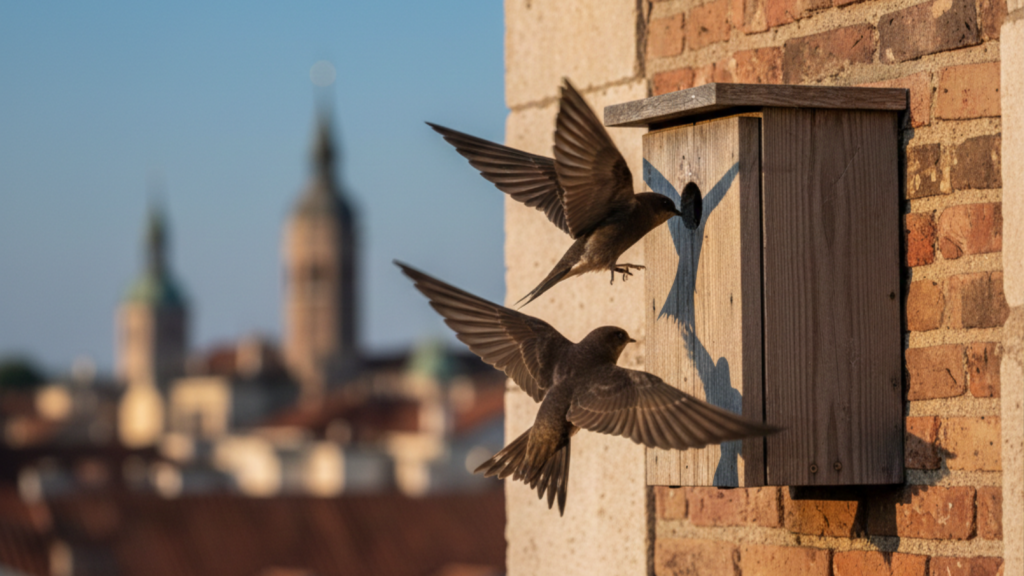
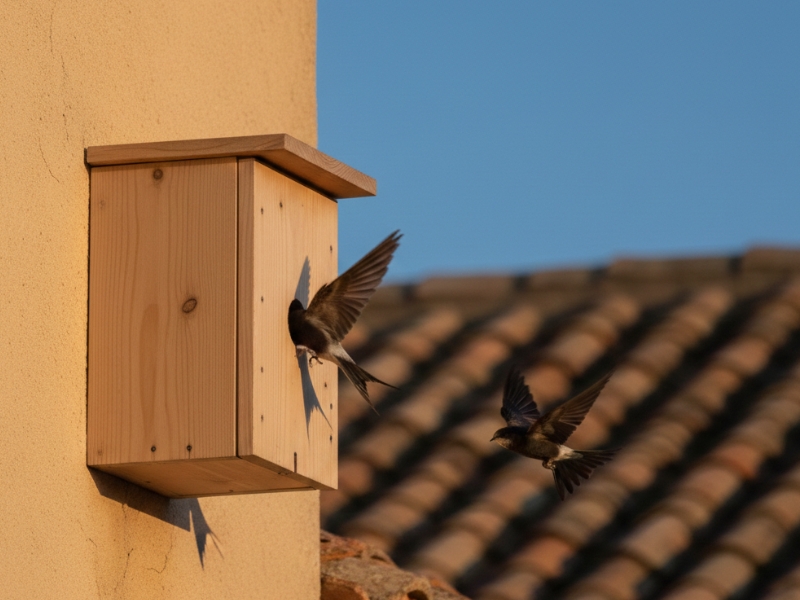
- Purpose-built nest boxes: if you’re doing construction work, you can install nest boxes integrated into the facade. They blend in visually and you’re giving the birds a safe home for life.
- Keeping the cavities open: sometimes all it takes is a small PVC tube running through the insulation so the birds still have access to the air cavity behind it.
- Timing the work: avoid facade work between May and August. It’s the law in many Spanish regions, though sometimes the construction firms need reminding.
Why environmental education in the neighborhood matters
I love talking to my neighbors when I spot swifts. Sometimes people complain about marks on the facade or the noise. When you explain that those black birds are eating the mosquitoes that bite them at night, their expression changes.
The swift isn’t dirty. It’s one of the cleanest animals there is. The parents even carry the chicks’ fecal sacs out of the nest to keep it hygienic. We need to recover that culture of respect for urban wildlife. They aren’t intruders. They’re part of our community.
Spying on the sky: technology in the service of the common swift
For decades, what swifts did once they vanished from our skies in August was a total mystery. We knew they went to Africa, but where exactly? Where did they sleep? Thanks to geolocators, tiny devices weighing barely a gram that are fitted like a backpack, scientists at SEO/BirdLife and other organizations have revealed routes that look like they were plotted by high-precision GPS.
The invisible highway to the Congo
What they found is fascinating. Our swifts aren’t going for a stroll. They cross the Mediterranean, traverse the Sahara in epic multi-day nonstop flights, and settle in the forests of the Congo basin, or along the coast of Liberia.
The wildest part is that they don’t stay put. They follow the rain. They chase the insect blooms that tropical storms bring. They’re nomads of the air, tracking food across an entire continent. Looking at those maps of dots moving all over Africa, you realize that the swift you see on your street in Madrid or Seville is a citizen of the world with a global perspective most of us would envy.
The law is on your side: how to protect nests legally
This is something very few people know, and it gives me a real charge of justified anger every time I explain it. In Spain, the common swift, its chicks, and its nests are protected by law. It makes no difference whether the nest sits on a private building or a public one.
The legal framework: Royal Decree 139/2011
The common swift is included in the List of Wild Species under Special Protection. That means the following is strictly prohibited:
- Destroying, damaging, or removing their nests, even when they’re empty in winter, because as I told you, they’re faithful and come back to the same spot every year.
- Disturbing or harassing the birds during the breeding season.
- Removing chicks from the nest without authorization.
If you see a renovation company sealing nest cavities in the middle of spring, you have the power, and I’d say the moral duty, to report it to SEPRONA, the Civil Guard’s nature protection unit, or to your regional forest rangers. I’ve seen work stopped over this, and it’s a victory of life over concrete that makes me want to jump for joy. Urban biodiversity isn’t optional. It belongs to all of us.
The perfect refuge: how to build and install a swift box that actually works
For a swift to accept your invitation to move in, the box has to meet some strict rules. Remember that they come in and out hot, barely braking, so the design has to be functional and safe. I always say a badly made box is worse than no box at all, so let’s aim for excellence.
1. Materials: quality and health
Start with the material. Forget chemically treated wood, heavy varnishes, or plastics that heat up.
- Natural wood: use pine board or sustainably grown timber (FSC), around 15 to 20 mm thick, roughly three quarters of an inch. That thickness is vital for thermal insulation.
- No toxic treatments: don’t paint the inside. On the outside, if you want it to last, use water-based eco stains or linseed oil. Chemical smells drive birds away.
- Fixings: use stainless or galvanized screws so the rain doesn’t rot them out in two winters.
2. Technical dimensions: the swift gold standard
Swifts need horizontal space, not vertical, unlike tits. Here are the dimensions I always recommend:
- Total width: 40 cm, about 16 inches. It’s a long, low box.
- Depth: 20 cm, about 8 inches.
- Height: 15 to 18 cm, 6 to 7 inches.
- The entrance, and this is the most important part: it should be an oval slot at the bottom of one of the front sides. The ideal size is 60 mm wide by 30 mm high, roughly 2⅜ by 1⅛ inches. Any bigger and starlings or sparrows will move in and evict the swift. Any smaller and the swift won’t fit.
3. The masterstroke: the nest cup
Since the swift has almost no feet, piling up nesting material is hard work. One idea I love, and that works beautifully, is carving a shallow circular depression into the floor of the box, like a very shallow bowl, on the side opposite the entrance.
If you can’t carve it, glue down a small ring of hemp rope or wood. This keeps the eggs from rolling around the box and getting cold or breaking. It’s a five-star hotel touch.
4. Installation: where do I put my masterpiece?
This is where a lot of people go wrong, and it’s such a shame to see a beautiful box sit empty because of bad placement. Take note:
- Minimum height: at least 5 meters off the ground, about 16 feet. Swifts need a free fall to launch. If there are trees, cables, or streetlights right in front, they won’t move in.
- Orientation: north or northeast. In Spain, the afternoon sun from the west and south can turn the box into an oven and kill the chicks. Always look for shade from the facade itself.
- Grouping: swifts are social. If you have room, put two or three boxes together. The pull of a colony attracts them far more than a single lonely box.
5. The final trick: the call lure
Sometimes nest boxes take years to be discovered. There’s one hack that works so well it’s almost unfair. Play a recording of swift calls near the box on May mornings. Hearing what sounds like other birds, they’ll come to investigate and find your box far faster.
So what now? Your commitment to the sky
Building this box is an act of love toward the natural world. Picture the satisfaction of drinking your coffee on the balcony and watching a pair of swifts that have traveled from the Congo choose your box, of all the places on earth, to bring a new generation into the world. That connection is what makes us human, and it gives us back a sense of belonging to this planet.
Frequently asked questions about the common swift
I know that after all that, your head is full of questions. Here are the most common ones:
How long does a swift live?
It sounds unbelievable for an animal so small that burns so much energy, but they average ten to twelve years. Individuals of up to twenty-one years have been recorded. Imagine the mileage that little bird has stacked up on its wings.
Why do they scream so much at dusk?
Those group chases along the facades, shrieking as they go, are called screaming parties. It’s a form of social communication, most likely to strengthen bonds and mark out the colony’s territory. It’s their way of saying: hey, we’re here, and this is our block.
Are swallows and swifts related?
Not at all. It’s one of the biggest mix-ups out there. Evolutionarily, swifts are closer to hummingbirds than to swallows. They’ve simply developed similar shapes because both hunt insects on the wing. In biology we call that convergent evolution.
Can I put a nest box on my balcony?
Yes, please do. Keep in mind that swifts are very particular, though. The box needs height, 5 meters or about 16 feet as an absolute minimum, nothing obstructing the front so they can fly in and out at full speed, and ideally a north or northeast aspect so they don’t roast in the afternoon sun.
How do I tell them apart from a house martin?
The house martin has a white belly and a white rump, the patch just above the tail. The swift is dark all over and its wings are much longer and crescent-shaped. If you see a bird that looks like a black arrow and never perches on wires, it’s a swift.
Become a guardian of the urban sky
At this point I feel like you and I already share something: respect for these extraordinary creatures. The swift teaches us that you can live up high, that persistence is the key to survival, and that borders only exist on human maps.
My invitation today is simple. Next time you walk through your city, look up. Listen for the scream. Feel them as part of your life. If you see their home in danger, don’t stand by. Your voice is the only one they have in our world of concrete.
I’d love this post to be the start of a real conversation. Have you seen your first swifts this year? Is there a colony near your window that brightens your mornings? Have you ever had to rescue one?
Tell me everything in the comments. It thrills me to know there are more people out there who feel this pull toward urban wildlife. Sharing these stories makes us feel less alone and a lot more connected to the pulse of the planet.