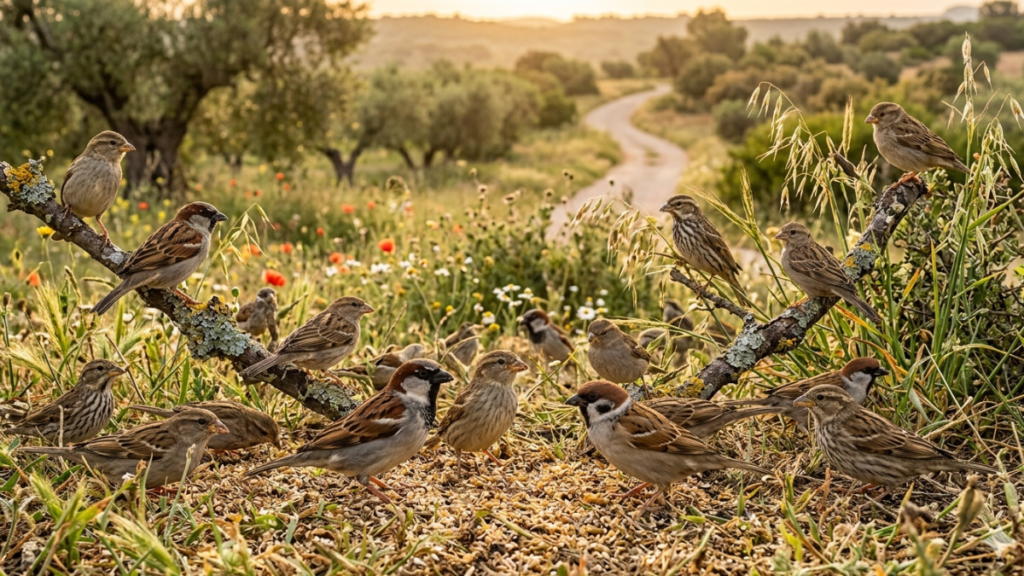
Facts about Passer domesticus, the house sparrow, that you probably don’t know: from its genetic coevolution with humans and its use of cigarette butts in nests, to the scientific causes behind its current disappearance.
The house sparrow (Passer domesticus) represents one of the great success stories of evolutionary biology, and right now, one of its great puzzles. Often overlooked precisely because it’s everywhere, this passerine has coevolved alongside humans for the last 10,000 years, tying its genetic fate to the development of agriculture and the rise of cities. In North America it arrived late, released in Brooklyn in 1851, and crossed the continent in under a hundred years.
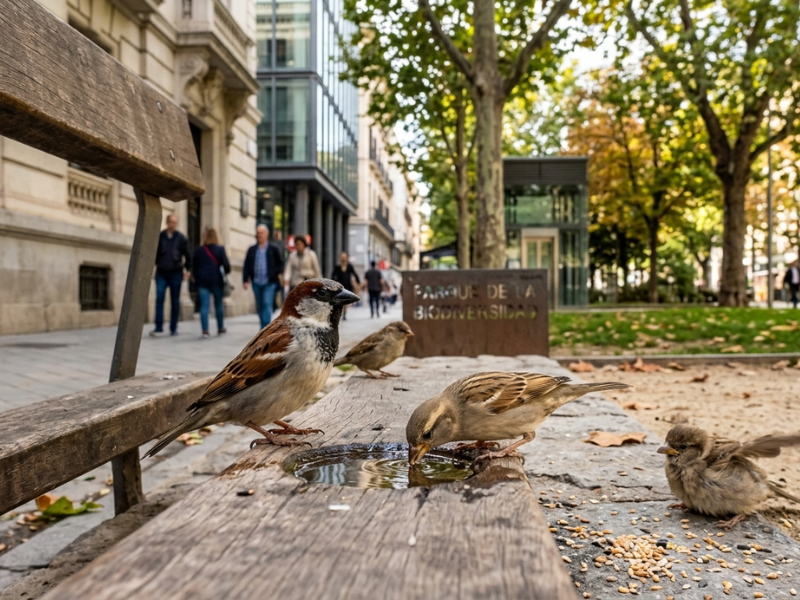
House sparrows in the city
This post contains affiliate links. If you buy through them you’re supporting my work, at no extra cost to you.
1. Phylogeny and evolutionary divergence
The sparrow’s story didn’t start in cities. It started in the Fertile Crescent. Recent genomic work suggests that the house sparrow split from its closest relative, the Spanish sparrow (Passer hispaniolensis), somewhere between 11,000 and 25,000 years ago.
To understand the sparrow, we have to drop the idea that any small brown bird is a sparrow. Taxonomically, they belong to the family Passeridae.
Scientific classification
- Kingdom: Animalia
- Phylum: Chordata
- Class: Aves
- Order: Passeriformes
- Family: Passeridae
- Genus: Passer
The most iconic member is the house sparrow (Passer domesticus), but there are more than 25 species in the genus Passer.
The sparrow doesn’t stand out for vivid color the way a goldfinch does, but its design is a masterpiece of efficiency.
Sexual dimorphism
Unlike a lot of birds, house sparrows are easy to sex in the field:
- Males: a black bib on the chest, and the bigger and darker it is, the higher their social standing. Gray crown, chestnut nape.
- Females: more uniform, sandy and brown, with a distinctive pale eyebrow stripe.
The house sparrow dominates American cities, but it’s worth separating it from the other birds we call sparrows here. That name causes real confusion, because North America’s native sparrows aren’t even in the same family:
| Species | Scientific name | Family | Distinguishing feature |
|---|---|---|---|
| House sparrow | Passer domesticus | Passeridae | Male has a black bib. Introduced from Europe. |
| Eurasian tree sparrow | Passer montanus | Passeridae | Black spot on a white cheek; both sexes alike. In the US, found only around St. Louis. |
| Song sparrow | Melospiza melodia | Passerellidae | Heavy brown streaking with a dark central spot on the breast. Native. |
| White-throated sparrow | Zonotrichia albicollis | Passerellidae | Crisp white throat and a yellow spot between eye and bill. Native. |
Physical adaptations
- The bill: stout and conical, a perfect tool for crushing seeds, though their diet is thoroughly opportunistic.
- Flight: short, rounded wings, which give them fast takeoffs and the maneuverability to handle dense urban space.
The starch adaptation
A study published in Royal Society Open Science found that house sparrows carry a variant of the AMY2B gene (pancreatic amylase), similar to the one dogs developed during domestication. That adaptation lets them digest the starch in cultivated grain, an evolutionary edge their wild relatives don’t share to the same degree.
2. Specialized anatomy and physiology
The sparrow’s build is a balance between thermal resilience and metabolic efficiency.
Respiration and thermoregulation
Like all birds, they have air sacs that push air through the lungs in one direction. That’s essential for sustaining a high metabolism:
- Heart rate: can exceed 600 beats per minute during activity.
- Body temperature: runs between 40°C and 42°C, roughly 104°F to 108°F.
The digestive tract
Because they’re seed eaters, they have a heavily muscled gizzard. As they feed, they swallow small stones, known as grit, which work like mechanical molars to grind down the cellulose and silica in seeds.
3. Complex social behavior: the psychology of the colony
Sparrow flocking isn’t just birds bunching together. It’s a social structure built on visual signals and dominance hierarchies.
Honest signaling: the bib as a badge of status
The black patch on a male’s chest is an indicator of testosterone and immune capacity.
- Hierarchy: individuals with larger patches get priority access to food sources and to the best nesting spots.
- Energetic cost: carrying a big bib means absorbing a lot of aggression from other males, which ensures that only genuinely fit individuals wear a prominent status signal.
Acoustic communication
Their repertoire isn’t musical in the human sense, but it’s highly functional. They have specific calls for specific jobs:
- Aerial alarm: for birds of prey, hawks and falcons.
- Ground alarm: for cats or people.
- Recruitment call: to tell the colony about an abundant food source.
4. Breeding ecology: strategies for success
The sparrow’s reproductive capacity is its main insurance against high juvenile mortality.
Breeding parameters
- Timing: at temperate latitudes they can manage two to four clutches a year, between March and August.
- Parental investment: both sexes incubate, though the female puts in more of the night shift. Feeding the chicks is intensive, with trips to the nest every few minutes throughout daylight hours.
Sexual selection at work
They’re socially monogamous, and extra-pair paternity is still common. Females often seek copulations with males carrying a larger bib than their own partner, improving the genetic load of their offspring while the official male helps with the rearing.
5. The sparrow in the 21st century: a population in crisis
Generalist or not, sparrow numbers are clearly falling. In cities like London, populations have dropped by more than 90 percent over the last three decades. North American numbers have fallen sharply over the same period.
The stress factors, one by one
A. Nutritional deficit, or city sickness
Access to junk food, pastries and white bread, delivers calories without the nutrients sparrows actually need. That produces hypovitaminosis, weakening the immune system of chicks before they can even leave the nest.
B. Habitat fragmentation and the desert effect
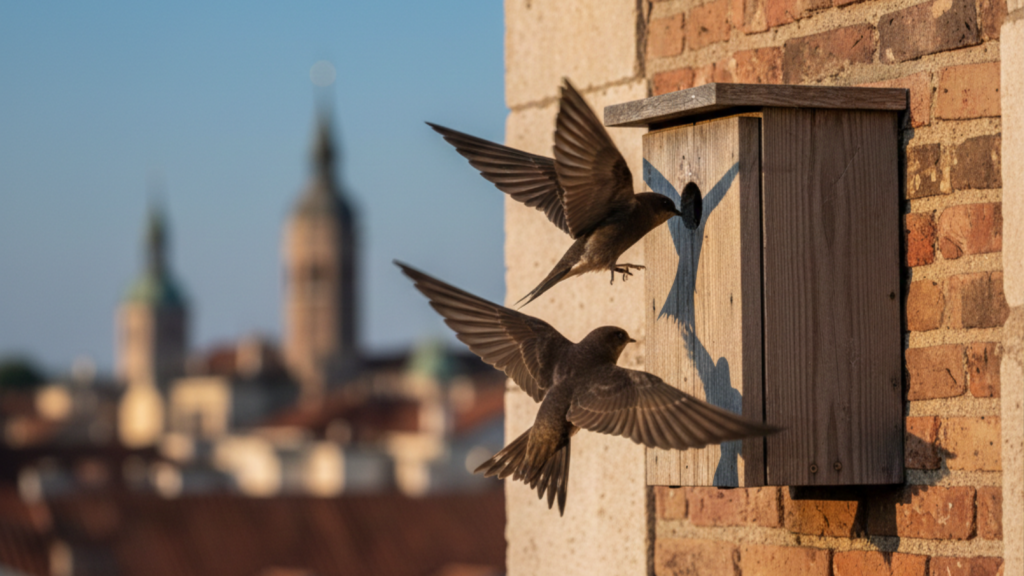
Modern bioclimatic architecture eliminates the vents and air cavities that old buildings had. Without those niches, the sparrow has nowhere safe from predators to nest.
C. Competition with introduced species
In many cities the sparrow competes for food and space with European starlings and house finches, and in places like Chicago, Brooklyn, and South Florida with monk parakeets (Myiopsitta monachus), all of them aggressive about the same resources.
6. Disease and public health
It’s worth addressing the sparrow’s role as a disease reservoir, though the risk to people is low as long as basic hygiene is maintained.
- Salmonellosis: one of the most common causes of mass mortality at winter feeders.
- Avian malaria (Plasmodium relictum): harmless to humans, and devastating for bird populations already under environmental stress.
- West Nile virus: sparrows can act as amplifying hosts for the virus, which spreads through mosquitoes.
7. Economic and cultural importance
The Great Leap Forward and the war on sparrows
The essential historical case study is the Four Pests Campaign in China, launched in 1958. Mao Zedong ordered the extermination of sparrows on the grounds that they were eating the grain.
- Consequence: killing millions of sparrows triggered a population explosion of locusts and other insects the birds had been keeping in check.
- Result: a devastating famine that killed millions of people. It remains the definitive proof of the sparrow’s regulating role in agricultural ecosystems.
8. Management and conservation: how do we turn it around?
Restoring urban biodiversity
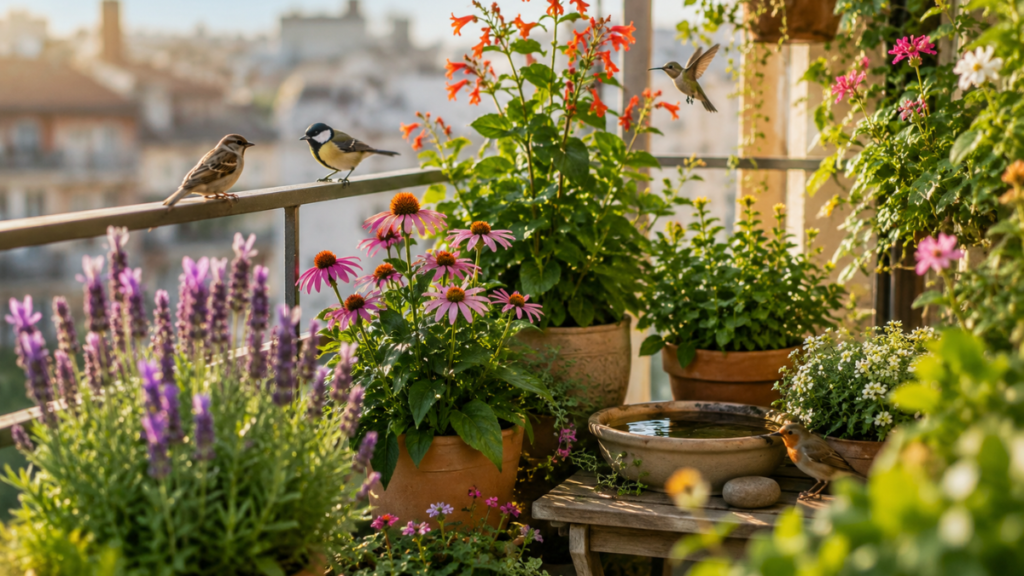
- Controlled-mess gardening: leaving areas of long grass lets insects complete their life cycles, which supplies protein to the birds.
- Replacing non-native hedges: swap ornamental hedging for native shrubs like elderberry, serviceberry, or native hawthorn, which offer berries and thorny cover against cats.
- Architectural integration: building nest bricks into new construction projects.
9. The genus Passer around the world
| Species | Distribution | Key adaptation |
|---|---|---|
| Passer ammodendri | Central Asia | Adapted to saxaul deserts. |
| Passer italiae | Italy | Stabilized hybrid of house sparrow and Spanish sparrow. |
| Passer luteus | African Sahel | Highly nomadic, follows the rains. |
10. Life in the city: evolutionary adaptation at the extreme
The urban environment isn’t a natural habitat for the sparrow. It’s a replacement ecosystem, and living in it has forced the bird to modify ancestral behaviors.
Disrupted circadian rhythms
Light pollution in cities has pushed the house sparrow to reset its biological clock. Chronobiology studies indicate that urban sparrows start their day up to 90 minutes earlier than rural ones.
- Advantage: early access to resources, before competitors or predators show up.
- Cost: chronic metabolic stress and a shorter life expectancy, from lack of neural rest and disrupted melatonin.
Cigarette butts in the nest
One fascinating phenomenon, documented by urban ecologists, is the use of cigarette butts in nest construction.
- Function: butts hold residual nicotine, a natural insecticide. By working them in, sparrows reduce the load of ectoparasites, mites and lice, that would otherwise hit the chicks.
- Side effect: over the long run, exposure to tobacco chemicals causes genotoxic damage in the offspring, which shows how double-edged urban adaptation can be.
Watchfulness and fear: flight initiation distance
In the city, the sparrow has developed an extremely plastic flight initiation distance. They can tell the difference between a person walking past distracted, a low threat, and one looking straight at them, a high threat. That capacity for interspecific discrimination is a marker of higher cognitive intelligence.
11. Advanced observation guide: urban birding
Watching sparrows isn’t simply looking at birds. Reading complex behavior takes method.
Recommended gear
- Binoculars: a pair of 8x42s is ideal for urban settings, thanks to the brightness and the field of view.
- Field notebook: for recording the ethogram, an inventory of observed behaviors.
- Macro lens: if photography interests you, for catching feather detail and bill wear.
What to look for: the sparrow ethogram
When you watch a colony, try to pick out these roles and actions:
- The sentinel: while the colony feeds on the ground, one or two individuals will post up somewhere high, a branch or a street sign. Their job is to sound the alarm when a cat or a hawk appears.
- Sun-basking: sparrows fluff up and spread their wings in the sun so that parasites start moving and become easier to pick off during preening.
- Courtship feeding: watch for the male feeding the female during courtship, demonstrating that he can provide.
Key locations
- Café patios: prime vantage points for watching kleptoparasitism, otherwise known as stealing food.
- Privet or boxwood hedges: their headquarters, where they shelter and socialize.
- Public fountains: critical spots for observing bathing and drinking behavior.
12. Frequently asked questions about sparrows
Why do sparrows hop instead of walk?
It’s a biomechanical adaptation. Their legs are short and their flexor muscles are built for fast takeoff and for hopping between branches. They can take individual steps, but hopping is the most energy-efficient method for a bird of that size and shape.
Can sparrows recognize human faces?
There’s evidence that urban passerines can recognize individuals who feed them regularly, or who have tried to catch them, associating facial features with either reward or danger.
What do I do if I find a sparrow chick on the ground?
This is the most common question of all.
If it has feathers, it’s a fledgling. It’s learning to fly and its parents are nearby. Don’t pick it up unless it’s in immediate danger from cats or traffic. Move it to a nearby branch.
If it has no feathers, it’s a nestling that has fallen out. Try to find the nest and put it back. If that’s impossible, contact a licensed wildlife rehabilitator. Never give it milk or bread. You could kill it.
How do sparrows tell good seeds from bad ones?
They use mechanoreceptors in the bill and tongue that register hardness and weight. They also have tetrachromatic vision, which lets them see into the ultraviolet spectrum, helping them judge the freshness of certain fruits and seeds that reflect UV light.
13. The human-sparrow relationship: a long history
The sparrow has gone from a symbol of fertility in ancient Greece, associated with Aphrodite, to a declared pest in eighteenth-century Europe, and finally to a symbol of the fight for urban conservation.
The sparrow in literature and culture
From the poems of Catullus onward, this bird has stood for the ordinary and the humble. Its current disappearance is read by many sociologists as the loss of the last link the average city dweller has to wild nature.
14. Glossary for the specialist observer
- Anthropocene: the current geological epoch, defined by the dominant human impact on climate and ecosystems.
- Philopatry: the tendency of an individual to stay in its birthplace, or return to it to breed. Sparrows are highly philopatric.
- Chirrup call: the basic social contact call that keeps the flock together.
- Melanism: a genetic condition producing excess dark pigmentation. In heavily polluted cities, sparrows with darker than normal plumage have been recorded, though this shouldn’t be confused with soot.
- Altricial: young that hatch blind, without down, and entirely dependent on their parents.
- Bioindicator: a species whose presence, absence, or condition reveals the environmental quality of an ecosystem.
- Epigenetic status: changes in gene expression driven by environmental factors, such as urban pollution.
- Gregariousness: the tendency of a species to live in organized groups or communities.
15. Citizen science methodology
You can contribute to science from your own window:
- Platforms like eBird and iNaturalist: log your sightings. Scientists use this data to map the species’ decline in real time.
- Seasonal counts: take part in organized counts like the Great Backyard Bird Count or Audubon’s Christmas Bird Count. This is the data that makes it possible to push governments toward changing urban planning policy.
The house sparrow is a lot more than a gray-brown bird on the asphalt. It’s a natural survivor, a social strategist, and a silent witness to our own urban evolution. Understanding its biology, respecting its space, and encouraging its presence isn’t just kindness toward an animal. It’s an investment in the sustainability of our cities. If the sparrow is doing well, the air we breathe and the places we live still have a chance.