Discover the life of barn swallows, their astonishing migration routes, how to protect their nests without much effort, and the best advice for living alongside them at home without ruining your wall.
If you’ve found your way to this corner of the internet, chances are we share a particular weakness. That moment in the year when you look up, hear a familiar chatter, and know spring has finally shown up at your door.
I’m talking about them, the travelers who come back year after year to the same corner of the porch, crossing thousands of miles of desert and ocean just to get home.
I’ve always had a deep connection to the natural world. I’m one of those people who can’t help stopping to watch an insect haul a leaf across the ground, or to see how the plants on the terrace respond to the first rain.
I go wherever my curiosity pulls me, and lately my head keeps circling back to the wonderful, fragile life of the barn swallow. In a world moving this fast, they remind us that cycles matter, and that showing up year after year is worth something.
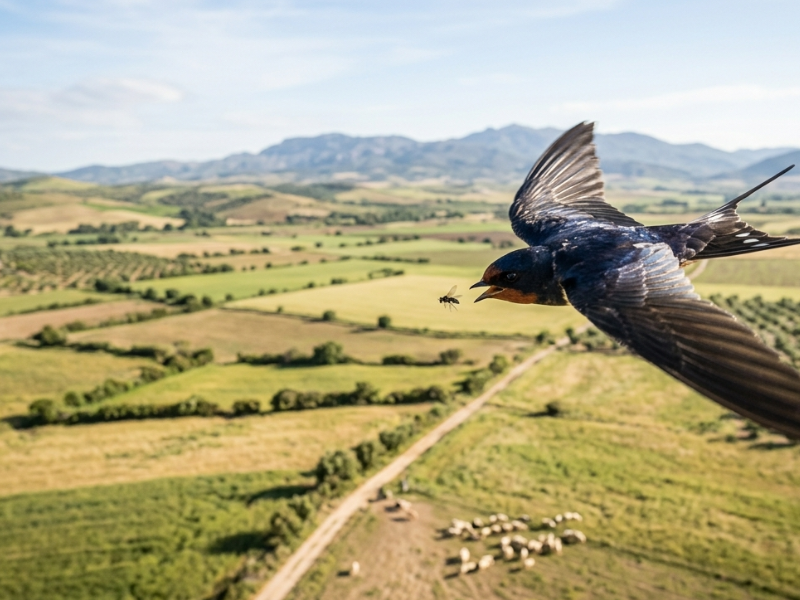
The images in this post were created for illustrative purposes with the help of AI
This post contains affiliate links. If you use them you’re helping me out, at no extra cost to you.
Who exactly are our rooftop companions?
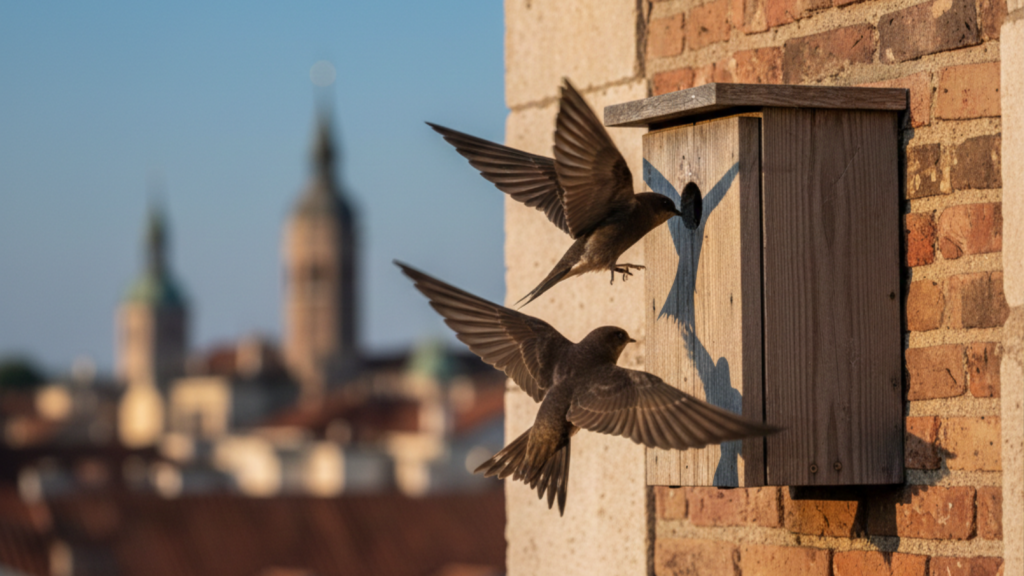
Sometimes we see them cut across the sky like sparks and we can’t tell whether what just shot past the window was a barn swallow, a cliff swallow, or a swift.
That’s normal. They move so fast that all you catch is a dark shape and a rhythmic flicker. Stop and look closely, though, and you find that each one has its own personality and its own perfect design.
The barn swallow next to the other sky acrobats
Three species share our towns and cities through the warm months, and people mix them up constantly. Learning to tell them apart is worth the effort.
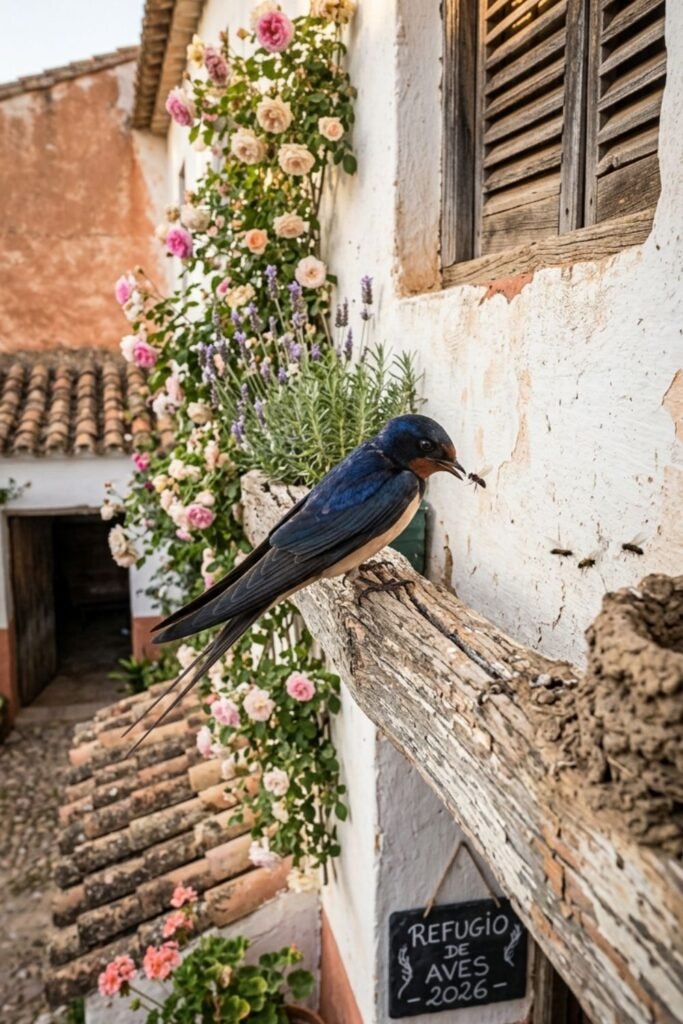
The barn swallow, today’s protagonist, stands out for its slim silhouette and those very long outer tail feathers ending in two fine points, like the tips of a pair of scissors.
If you catch one perched on a wire, what grabs you is the forehead and throat in that distinctive rusty red, set against the deep metallic blue of the back and the cream white of the belly.
The cliff swallow, by contrast, is chunkier and smaller. It has none of those long tail streamers, and its tail is short and squared off. The back is dark too, but there’s an obvious pale buffy patch right above the tail, on the rump, which makes it look like it’s wearing a little diaper in flight.
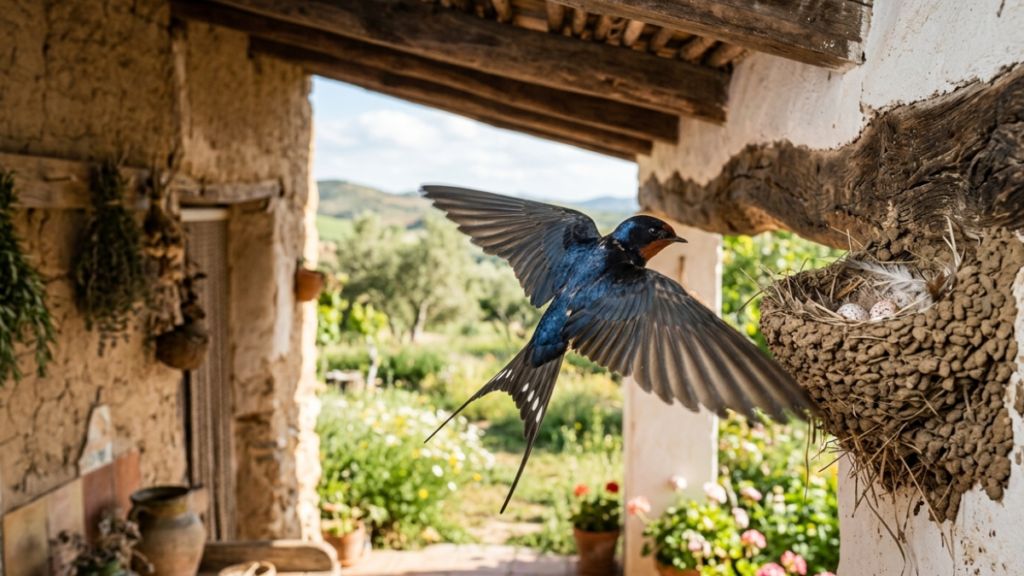
Their nests are completely different as well. Cliff swallows build fully enclosed gourds of mud with one small tunnel entrance, packed side by side in colonies under eaves and bridges. Barn swallow nests are open cups.
Finally, the chimney swift is the king of speed. It’s entirely dark, nearly black, with a silhouette people describe as a flying cigar. Swifts barely touch down in their whole lives. They eat, sleep, and mate on the wing, and only land to breed. Their calls are those high chattering notes that fill summer evenings over the rooftops.
What a barn swallow actually looks like
The barn swallow’s body is a masterpiece of aerodynamics. It weighs barely twenty grams, about three quarters of an ounce, the equivalent of a spoonful of sugar, and its bones and muscles are built to handle entire days of flight without wearing out.
The wings are long and pointed, which lets it turn tight in midair to grab insects as it goes.
The bill is very short but the mouth is wide, working like a funnel when the bird flies fast with its mouth open, scooping up flies, mosquitoes, and small beetles.
The color of the plumage shifts with the light. In shade it can look black. In direct sun it shines with metallic blues and violets worth stopping for.
The breast is a dirty white or buff, which helps camouflage the bird when a predator looks up at it against a bright sky.
Their song, the chatter that makes a morning
The barn swallow’s song isn’t loud or shrill. It’s a constant, cheerful chatter full of variation. It usually starts with quick high notes and finishes on a distinctive rasping buzz that always settles me.
They love singing from power lines, balcony railings, or the bare branches of trees near their nests. It’s how they communicate with a mate, mark territory, and announce that in this particular corner of the world, things are going fine.
For me, hearing that chatter first thing in the morning while I open the windows for fresh air is the best proof that life is running its natural course.
The great journey: barn swallow migration
What fascinates me most about these birds is their ability to navigate, to make journeys that would strike us as impossible with nothing but what they carry.
Picture for a second what it takes to cross entire continents guided by nothing but the stars, the earth’s magnetic field, and the landscape underneath you.
Where do they go when it starts to cool off?
When summer winds down and the days start shortening, the number of insects in the air drops sharply. For a bird that eats nothing but flying insects, staying put through winter would mean starving to death.
So from late August through September, barn swallows start gathering in large flocks.
If you live near wetlands, marshes, or reed beds, you’ve probably seen thousands of them come together at dusk to roost before setting off.
Their destination is Central and South America. They funnel down through Texas and Mexico, and the coastal plain around Veracruz becomes one of the great migration bottlenecks on earth, with millions of birds pouring through a narrow corridor between the mountains and the Gulf.
From there some stop in Panama and Colombia, while others push much farther south, all the way to Brazil and Argentina. For the birds making the longest trip, we’re talking about six or seven thousand miles each way.
The astonishing return to last year’s nest
The most moving part of the whole process is their faithfulness. A swallow that survives the winter in South America will come back to exactly the same town, the same street, and if it can, the same nest it built or used the year before.
How do they do it? They have astonishing spatial memory and a particular sensitivity to the earth’s magnetic field.
They use the sun by day and the constellations by night to hold a rough heading, and as they close in on the destination they start recognizing landforms, rivers, mountains, and finally the shape of the buildings on our own street.
Getting back to the old nest saves them an enormous amount of energy. Building one from scratch takes a colossal effort, which we’ll get into shortly, so reclaiming the old house lets them start breeding sooner and with far better odds.
The invisible dangers along the way
The migration is an obstacle course, and plenty of swallows lose their lives on it. Climate change is shifting wind patterns and making storms along the route more frequent and more violent, which can blow flocks off course or exhaust them to death.
Drought in the stopover areas makes it harder for them to refuel.
Add to that habitat loss from deforestation and the heavy use of pesticides across the farmland they pass through, which cuts the available food dramatically.
The crossing of the Gulf of Mexico is its own ordeal. Birds that attempt it fly for hours over open water with nowhere to land, and a storm at the wrong moment can wipe out large numbers at once.
The art of building a home from mud and saliva
Watching a pair of barn swallows build a nest is a lesson in architecture, patience, and cooperation.
It’s a meticulous process that takes days of steady work and produces a structure that’s surprisingly tough.
How they choose the perfect spot
Cliff swallows plaster their nests on the outside of walls, under the overhang of a roof or a bridge. Barn swallows are more domestic about it, looking for semi-enclosed spaces that are sheltered from the weather.
They love porches, garages left open during the day, sheds, barns, covered walkways, and the wooden beams of a carport. It’s no accident that the species is named after the barn.
They want a rough surface, stone, brick, or untreated wood, where mud will stick easily. They also want somewhere hard for the usual predators to reach, cats and jays in particular.
Building the nest, step by step
Once the site is chosen, the pair works together. They head for the edges of puddles, riverbanks, or irrigated ground, anywhere they can find clay-heavy mud with the right texture.
They pick up small pellets of mud in the bill and mix them with their own saliva, which acts as a natural binder. They work in dry grass stems, animal hair, and bits of straw to give the mixture consistency and flex, very much the way people have always made traditional adobe.
Then they fly back and place the pellets one at a time, pressing with the bill to fix each one to the wall. To build a single nest, a pair can make more than a thousand round trips over ten to fifteen days.
What they end up with is that beautiful open cup, and once it dries it’s strong enough to hold both adults plus five or six chicks growing at a ferocious rate inside it.
To finish, they line the inside with soft material for warmth and comfort: feathers caught in midair, wool, moss, and fresh leaves. They want their future kids as comfortable and protected as possible.
Why destroying their nests is a terrible idea, and often illegal
You’ve probably seen or heard about someone knocking down a swallow nest because the mess on the wall bothered them. It breaks my heart every time.
It’s cruel to birds that have flown thousands of miles to breed, and in the United States it’s also against federal law.
Barn swallows are protected under the Migratory Bird Treaty Act. Destroying or removing a nest that holds eggs or chicks is a federal offense, and the penalties are serious. Inactive nests outside the breeding season can generally be taken down, but check your state rules first, and understand what you’re doing when you do it.
Beyond the law and the fines, which in the end are just rules on paper, this comes down to empathy, and to understanding what these birds actually do for us.
Knocking down their home sets them back badly in a fight they’re already losing.
Family life: courtship, eggs, and very hungry chicks
Breeding season is the busiest and most stressful stretch of a swallow’s year. Everything is timed to the millimeter so the chicks hatch when insects are most abundant.
Courtship and choosing a mate
When the males arrive in spring, they rush to claim the best nests or the best sites to build one. With the territory secured, they start singing insistently to attract the females arriving behind them.
During courtship the male spreads his tail to show the small white spots on the feathers, an indicator of health and vigor.
Females tend to choose the males with the longest, most symmetrical tail streamers, because that demonstrates excellent flying, which in turn means the bird will be very good at bringing home food for the chicks.
Once the pair forms, they usually stay faithful through the breeding season, and in many cases they pair up again the following year if both survive the migration.
Incubation and parental teamwork
The female usually lays between four and six white eggs speckled with reddish brown.
Incubation runs about two weeks and falls mainly to the female, though the male makes sure she’s fed and takes brief shifts when she needs to stretch her wings and drink.
It’s the calm before the storm. The parents tend the eggs carefully, holding them at a steady temperature of around 99°F and turning them gently at intervals so the embryo develops evenly.
Leaving the nest and learning to fly
When the chicks hatch they’re completely helpless. No feathers, eyes closed, entirely dependent on the warmth and food their parents bring.
Over the next three weeks the parents work at a frantic pace. They can make hundreds of trips a day to bring food in.
They feed the chicks small balls of insects packed together with saliva, rich in protein and water. It’s remarkable to watch the chicks push their yellow gapes over the rim of the nest the second they hear their parents’ wingbeats, competing loudly for their share.
Three weeks after hatching the young are adult-sized with full plumage, though the colors are duller and the tail shorter. Then comes the crucial moment: the first flight.
The parents coax them by fluttering near the nest with food in their bills, pushing them to launch into open air. At first the landings are clumsy and the young birds settle on the nearest branch, shaking with fatigue.
For several more days the parents keep feeding them and teaching them the basics of hunting on the wing, until they’re fully independent and getting ready for their first great migration.
Active conservation: how to help them from home
Sometimes we feel powerless reading the news about biodiversity loss. We assume there’s nothing useful we can do from an apartment or a house.
With swallows it’s the opposite. Every small gesture counts and has a direct, visible effect on their lives.
What to do if you find a swallow chick on the ground
Through June and July it’s common to find chicks on the ground, especially on very hot days when they lean out for air and end up slipping.
The first thing to do is check whether the chick is injured or simply a fledgling learning to fly. If it has nearly complete feathers and moves around easily, the parents are probably nearby watching it.
In that case, if the spot is safe and there are no cats or cars around, the best thing is to leave it where it is or set it on a high branch nearby.
If the chick is very small, barely feathered, and the nest is within your reach, gently put it back. Don’t worry about the myth that the parents will reject it because you touched it. Birds have a poorly developed sense of smell and they’ll take it back without a problem.
If the nest is broken or out of reach, you can improvise one from a small cardboard box or a plastic cup with drainage holes in the bottom, lined with paper towel.
Put your improvised nest as close as you can to where the original was. The parents will usually hear their chick calling and come feed it right there.
If the bird is injured or weak, or the parents don’t show up within a few hours, the right move is to contact a licensed wildlife rehabilitator or your state wildlife agency for instructions. In the meantime, keep the bird in a closed cardboard box with air holes, somewhere warm, dark, and quiet, and don’t force food or water on it if you aren’t sure how.
Simple ways to give them mud and water in dry spells
Lack of mud is one of the biggest problems swallows run into in modern towns, where most of the ground is paved.
If they can’t find wet mud nearby, they can’t build or repair their nests, which forces them to look elsewhere or to delay laying.
If you have a yard, a patio, or a shared terrace, you can help enormously by making a mud source available in spring, particularly through April and May.
All it takes is a wide, shallow plastic tray on the ground, filled with a mix of clay soil and water worked to a paste, kept damp. Add a few strands of dry grass or fine straw and you’ve given them the perfect building material.
Put the tray somewhere open and clear where the birds can land and take off without worrying about predators.
Setting up a bird bath in the yard or on the terrace is a huge help too, and not only for swallows.
Change the water often so it stays clean, and scrub the basin to keep disease from spreading.
Clean solutions for living with droppings on your wall
Let’s not pretend otherwise: swallows make a mess of walls and floors underneath their nests.
That’s the main reason people don’t want them on their houses. The problem has an extremely simple fix, though, one that respects the birds and keeps your wall clean.
The most effective solution is mounting a shelf or a board just below the nest. Wood, plastic, or metal all work, and it should sit roughly sixteen to twenty inches under the base of the nest.
At that distance it doesn’t interfere with the birds flying in and out, and it catches everything that falls.
Once the breeding season is over and the swallows have started south, you can take the board down easily, scrub it with water and a brush, and store it for next year, or just leave it in place ready for spring.
It’s cheap, it takes ten minutes to install, and it proves that people and wildlife can share a building perfectly well if we’re willing to put in a little effort.
Planting biodiversity to keep them fed
Swallows eat insects. The more insects there are in your area, the easier it is for them to feed their chicks and stay healthy.
Instead of using chemical insecticides in the yard or in your balcony pots, which wipe out the insect life and contaminate the soil, build a space that draws biodiversity naturally.
Plant natives like goldenrod, milkweed, coneflower, and native asters, which support far more insect life than ornamentals do. Aromatic herbs like lavender, rosemary, thyme, sage, and mint work well in pots too, and they pull in a wide range of pollinators and small insects that feed our winged friends.
Building small pockets of living habitat at home helps weave a network of microhabitats that urban wildlife depends on.
Myths, legends, and our long history together
The relationship between people and swallows goes back a long way.
Because they seek us out to nest, they’ve turned up in the literature, the folklore, and the popular beliefs of a great many cultures across history.
A symbol of loyalty, home, and good luck
In European folk tradition, the arrival of swallows was always taken as a sign of good luck and prosperity for whichever house they chose.
The saying went that if a pair built its nest on your porch, that house was protected against lightning, fire, and misfortune.
There’s also a Christian legend widespread across rural Spain holding that swallows eased Christ’s suffering on the cross by pulling the thorns from his crown with their bills.
That’s why, according to the story, their throats were stained blood red forever, and harming them or destroying their nests was considered a grave sin that brought misfortune on the family.
At sea, sailors the world over tattooed a swallow on the chest as a symbol of good luck and safe return.
A sailor who spotted a swallow knew land was close and that the voyage was nearly over. To them it stood for loyalty and coming home, values that fit these birds perfectly.
The crucial role of swallows in traditional farming
Before modern chemical pesticides existed, farmers knew perfectly well that swallows were their best allies for protecting crops from insect outbreaks.
A single barn swallow can eat more than eight hundred insects in a day. Multiply that by a pair and their five chicks across a whole breeding season and one swallow family removes tens of thousands of flies, mosquitoes, aphids, and small beetles every month.
They’re among the most effective natural pest controls on the planet. Encouraging them on farms and ranches keeps the ecological balance and cuts the need for chemicals that harm human health and the environment.
Frequently asked questions about barn swallows
How long does a barn swallow live?
A swallow’s life usually isn’t very long, given the enormous risks it takes on migration and how demanding its lifestyle is.
Average life expectancy runs between three and four years. There are exceptional records of birds reaching eight or even ten, which means they completed the round trip to South America many times over. That’s a real feat of survival.
Do swallows sleep while flying, the way swifts do?
No, barn swallows don’t sleep in the air. Unlike swifts, which spend nearly their whole lives on the wing and can sleep with one hemisphere of the brain active while the other rests, swallows need to perch to sleep.
During breeding they sleep in the nest or on nearby branches, and on migration they gather in huge groups to roost overnight in marshes, reed beds, and leafy trees near water.
Do barn swallows mate for life?
Barn swallows are monogamous through the breeding season, meaning they form a stable pair to raise their chicks each year.
Plenty of males and females find each other at the same nest the following year and pick up where they left off, but if one of them doesn’t make it back from migration, the survivor won’t take long to find a new mate and get on with the season.
How do they drink if they almost never come down to the ground?
Swallows drink on the move, and it’s one of the prettiest maneuvers you’ll ever watch. They fly low over ponds, lakes, or still pools, open the bill, and skim the surface with the lower mandible to scoop up a few drops without ever breaking flight.
It’s a refined technique that takes real precision to pull off without going into the water.
Is it true that swallows flying low means rain is coming?
Yes, this piece of folk wisdom has a solid scientific basis. Before rain, relative humidity rises considerably and atmospheric pressure drops.
That loads the wings of flying insects with moisture, making them heavier and harder to fly with at altitude.
The insects are forced to fly much closer to the ground or the water, and swallows, which are simply following their food, drop their own flight altitude to keep hunting efficiently.
What’s the difference between a barn swallow and a tree swallow?
Tree swallows are the other swallow you’re most likely to see around houses in North America. They’re iridescent blue-green above and clean white below, with no rusty throat, and their tail is short and only slightly notched instead of carrying the barn swallow’s long streamers.
They nest completely differently too. Tree swallows are cavity nesters that readily take a nest box, while barn swallows build open mud cups on ledges and beams.
Why do we see fewer swallows every year?
Swallow populations are in worrying decline across North America and Europe alike.
The main causes are the heavy use of agricultural pesticides, which slashes the insect populations they feed on; the loss of suitable nesting habitat as buildings are modernized and the ledges and open structures disappear; and the steady decline of traditional small-scale livestock farming, which used to supply both abundant flies and building material near the barns.
A simple commitment for the future
I like thinking that each of us gets to decide what kind of relationship we want with what’s around us. We can look away and ignore the small daily miracles happening over our heads, or we can get involved, pay attention, and do our part to make sharing a street with wildlife easier and better.
Swallows don’t ask for much. A patch of wet mud in spring, a rough eave to anchor a nest to, and a little tolerance from us if they dirty a floor we can clean with a brush and a bucket, or protect with a plain board.
In exchange they give us their brightness, that steady chatter every morning, their steady work clearing the air of mosquitoes, and the particular feeling of being part of something bigger, a cycle that renews itself year after year without losing any of its pull.
Next time you hear that soft chattering from the power line, or see a fast shadow skim the street, stop for a second. Smile. Give them a nod.
Think about the incredible thousands of miles they covered just to be near you again, to bring your neighborhood back to life. They’ve earned our respect and our protection.
I’d love to know what you make of all this.
Do you have swallow nests at your house or on your street? How do you handle living with them? Have you ever watched the chicks hatch, or that thrilling moment of the first flight?
Please leave me a comment below and tell me about it. It genuinely makes my day to read your stories and share this love of the natural world with people like you.