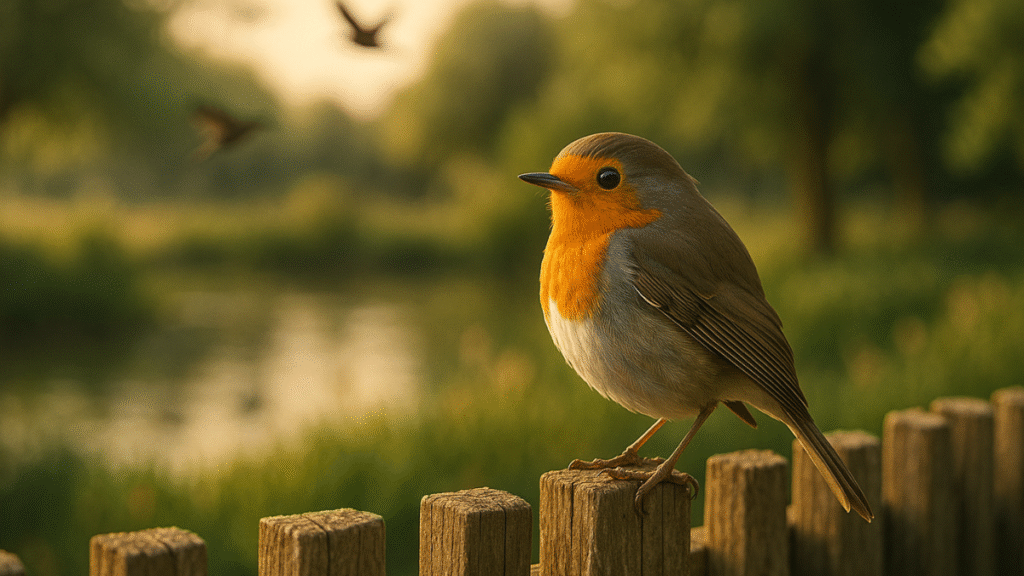
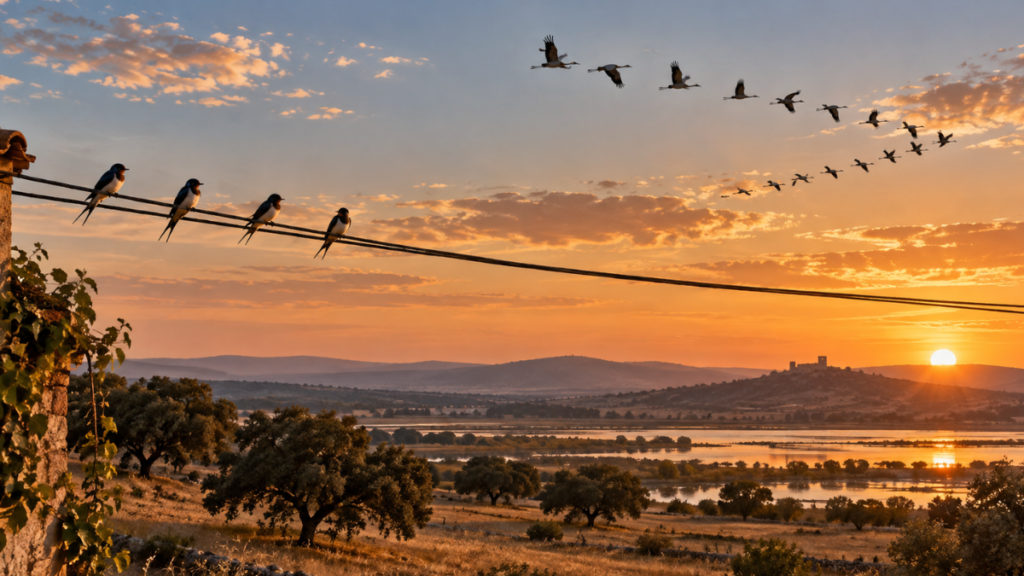
Every year around late August, something catches my attention, the birds that signal fall. I’ll be sitting on the porch, or walking a trail somewhere, and I’ll look up and just know. It’s not the cooler mornings or the shorter evenings. It’s something happening overhead, something about the way certain birds are moving that wasn’t there a week ago. And that’s when it hits me, fall is on its way.
I don’t need a calendar for this. I don’t need a weather app. I just need to pay attention to what’s going on above me. The birds tell me everything. And once you learn to read those signals, you never really unlearn it. It’s the kind of thing your body picks up on before your brain catches up.
So if you’ve ever wondered why the hummingbirds vanish in September, or where those V-shaped formations come from on an October evening, stick around.

The images in this post were created for illustrative purposes
What fall migration actually means and why it matters more than you think
Before we get into specific species, I want to make sure we’re on the same page about what’s actually happening when we talk about fall migration. Because a lot of people boil it down to “birds fly south when it gets cold,” and while that’s technically not wrong, it leaves out almost everything interesting.
Fall migration across North America is one of the largest movements of living things on the planet. Billions of birds, hundreds of species, traveling along four major flyways that run the length of the continent: the Atlantic, the Mississippi, the Central, and the Pacific. Think of them as invisible highways in the sky, routes encoded in the DNA of birds that have followed them for thousands of generations.
And it’s not just instinct. We’re talking about a navigation system that uses the Earth’s magnetic field, the position of the sun, the stars at night, and visual landmarks like the Great Lakes, the Appalachian ridge, the Rockies, and the coastline. Scientists still don’t fully understand how it all works.
What pushes birds to migrate isn’t really the cold itself. It’s food. When the days get shorter and temperatures drop, insects disappear, plants stop producing fruit, and the landscape becomes a lot less generous.
Birds that rely on those resources have no choice but to move somewhere that still has what they need.
Here’s the part that gets me every time. According to research from the Cornell Lab of Ornithology, roughly four billion birds migrate south through North America each fall. Four billion. Just on this continent. That makes it one of the biggest animal movements anywhere on Earth.
When I watch a flock of geese cross the sky in formation, I’m not looking at a nice seasonal decoration. I’m looking at thousands of years of evolution working exactly as it should. Every bird that migrates is putting its life on the line.
Some don’t make it. Many never come back. The ones that complete the journey do so because everything in their bodies, every cell and every instinct, is built for it.
That’s why I think it should matter to all of us. When a migratory species starts failing on its routes, when the numbers drop, when they show up late or don’t show up at all, that’s telling us something about the state of the world we live in.
Migratory birds are biological thermometers. They tell us whether things are working or whether something is breaking down.
The first clues in the sky: how to tell that fall is coming
There’s a window between mid-August and early September when everything starts to shift in quiet ways. And if you’re paying attention, the first thing you’ll notice is the birds.
The silence of the ones leaving
One of the earliest signs isn’t something you see. It’s something you stop hearing. By late summer, a lot of birds that have been singing for months go quiet. The woods and backyards that were a constant concert in June start getting noticeably still. Warblers, vireos, tanagers that filled the trees with color and sound begin to pull back. It’s a gradual silence, like someone slowly turning down the volume.
The ruby-throated hummingbirds that have been buzzing around feeders all summer with that relentless energy start showing up less often. One morning you realize it’s been two days since you’ve seen one. And if you’re tuned in, that absence registers right away.
Pre-departure gatherings and behavior shifts
A lot of migratory birds do something I find really interesting before they leave: they completely change their habits. European starlings, which are all over North America, start forming massive flocks. Red-winged blackbirds, common grackles, and brown-headed cowbirds group up in numbers that can reach hundreds of thousands, sweeping across fields and parking lots at dusk looking for places to roost.
These gatherings serve a purpose. It’s not just for show. Large groups offer protection from predators. And young birds making their first migration learn from the experienced adults. It’s a kind of collective warm-up, a “we’re heading out together, let’s get organized.”
Hawks and other raptors also start acting differently. Instead of patrolling their usual territory, you begin to spot groups of raptors moving in the same direction, riding thermals to gain altitude and glide without burning energy. It’s a clear sign that migration has kicked off.
Shifts in flight schedules
Another clue is that the timing of bird activity changes. In summer, many birds are most active at dawn and dusk, when the heat lets up. But in fall, that pattern shifts. You start seeing movement at unusual hours. Raptors kettling at midday. Flocks of geese crossing at noon. And above all, nighttime traffic that you can actually detect if you step outside on a clear September night and listen.
Most songbird migration happens after dark. If you pull up the weather radar on a fall night, you can watch it light up with millions of dots that aren’t rain. They’re birds.
The Cornell Lab’s BirdCast tool shows nocturnal migration in real time, and it’s genuinely fascinating to see the map come alive with travelers while the rest of us sleep.
All of it, if you know how to read it, is saying the same thing: the wheel is turning and fall is here.
The birds that announce fall across the United States: a species-by-species guide
Now for the part you’re probably most curious about: which specific birds can you watch for, and what are they telling you with their presence or their absence.
Ruby-throated hummingbirds: the first to pack up
If there’s one bird whose departure you notice immediately, it’s the ruby-throated hummingbird. Across the eastern half of the country, these tiny birds are a constant summer presence.
They hit feeders, hover among flowers, chase each other with an energy that seems impossible for something that weighs less than a nickel.
Their migration starts early. Males leave first, sometimes as early as July. Females and young birds follow through August and September. And here’s the part that still blows my mind in the quietest way: many ruby-throats cross the Gulf of Mexico in a single nonstop flight.
Over five hundred miles of open water with no place to stop. A bird that weighs a tenth of an ounce flying for eighteen to twenty hours straight over the ocean.
To prepare, they nearly double their body weight by storing fat. They go from about three grams to about six. And with that reserve, they launch across the Gulf. Some don’t make it. But most do, landing on the coast of the Yucatan or Central America to spend the winter.
When your hummingbird feeder goes quiet in September, fall has arrived. It’s one of the most reliable and most personal signs there is.

Ruby-throated hummingbirds
Canada geese: the sound everyone knows
If hummingbirds announce fall by leaving, Canada geese announce it by showing up loud and proud. There’s no more iconic fall signal in North America than that V-formation crossing the sky with that deep, honking call you hear before you even spot them.
Canada geese breed across the northern part of the continent, from Alaska to the Canadian provinces, and start heading south from September onward.
During fall you can see them just about everywhere in the US, from the farmlands of the Midwest to the parks of East Coast cities.
They fly in V-formation because it saves energy. The bird at the front breaks the air and creates a slipstream for the ones behind it. They rotate the lead position. And they call to each other the entire way, those honks you can hear from a remarkable distance.
Every fall, the first time I hear geese overhead, I stop whatever I’m doing and listen. It doesn’t matter where I am. That sound has something in it that connects me to the season in a way I can’t quite put into words. It’s like fall has a soundtrack, and the geese are in charge of playing it.
A lot of Canada goose populations have become year-round residents in suburban and urban areas. The ones hanging around your local pond all summer probably aren’t going anywhere.
But the ones passing overhead in tight formation at altitude, those are the real travelers. And their flight sets the rhythm of the season.
Raptors: the spectacle along the mountain ridges
The fall raptor migration is one of the great shows in North American birding. And it has a very specific stage: the mountain ridgelines, especially the Appalachians.
Broad-winged hawks are the headliners. They migrate in September, and they do it in groups that can number in the thousands, swirling upward in what birders call kettles because the spiraling mass of birds rising on a thermal looks like steam coming off a pot. A good migration day at a place like Hawk Mountain in Pennsylvania can give you the chance to see thousands of broad-wings in just a few hours.
Alongside them come Cooper’s hawks, sharp-shinned hawks, golden eagles, northern harriers, and later in the season, peregrine falcons and goshawks. Each species has its window. September belongs to the broad-wings. October brings more variety. And November is for the golden and bald eagles, the last big movers of the season.
Raptors avoid crossing large bodies of open water because they depend on thermals to soar. That’s why they funnel along mountain ridges, where wind hitting the slopes creates updrafts they can ride for free.
The Appalachian crests work like a natural highway for raptors, channeling them into a stream that observers can follow from lookout points.
I’ve stood at Hawk Ridge in Duluth, Minnesota, on a September day with a northwest wind and watched thousands of raptors pass overhead in a matter of hours. It’s the kind of experience that permanently changes how you look at the sky.

Raptors
Warblers: the invisible travelers that paint the fall
If there’s one group of birds that defines fall migration in North America more than any other, it’s the warblers. Birders are obsessed with them, and for good reason. More than fifty species of warblers breed across the US and Canada, and nearly all of them migrate to Central America, the Caribbean, or South America for the winter.
The challenge, and part of the charm, is that warblers in fall are tough to identify. During breeding season, males wear bright, distinctive plumage that makes them easy to pick out. But come fall, they molt into duller, more muted versions of themselves. Olive-ish, yellowish, brownish, vaguely similar to three other species. Birders have a term for it: confusing fall warblers.
It fits perfectly, because you’ll find yourself staring at a small bird flitting through the leaves and having absolutely no idea which one it is.
But that doesn’t take away from what their presence means. When parks and green spaces fill up with small, busy birds working through the branches in September and October, many of them are warblers on the move. Central Park in New York is famous for this.
On a good fall morning, a walk through the Ramble can turn up ten or fifteen warbler species resting before they continue south. And it’s not just Central Park. Any patch of trees near a coast or a river can become a migration stopover.
They navigate by the stars and the Earth’s magnetic field, and at dawn they drop down to feed and rest. That’s why the best mornings for watching them are the ones that follow a night with north winds: those winds push the migrants south and concentrate them at rest stops along the way.
Birders call it a fallout, and when it happens, the trees seem to come alive with dozens of birds working every branch.
A warbler weighing a third of an ounce can fly over two thousand miles on its fall journey. Some, like the Blackburnian warbler, travel from the boreal forests of Canada all the way to the Andes in South America. A trip that spans an entire hemisphere in a body that fits in the palm of your hand. That deserves a moment of quiet respect.
Red-winged blackbirds and grackles: the dusk clouds of fall
If you’re looking for a fall signal that’s impossible to miss, pay attention to the flocks of red-winged blackbirds, common grackles, and brown-headed cowbirds that form from late summer through the fall months.
These birds, which tend to be more territorial and spread out during spring and summer, start grouping up in enormous flocks as fall settles in. Different species often mix together, creating swarms that can number in the hundreds of thousands.
At dusk, they converge on communal roosts, places where they spend the night packed together, and the noise they make as they settle in carries a long way.
Across much of the rural Midwest and South, these flocks are as much a part of the fall landscape as the leaves changing color. They line up on power lines, blanket harvested cornfields, fill parking lot trees at shopping centers.
They’re not the kind of birds that inspire the excitement of a raptor or the tenderness of a hummingbird, but their collective behavior in autumn is as clear a seasonal marker as anything else out there.

Red-winged blackbirds and grackles
Sandhill cranes: trumpets from above
Sandhill cranes are another fall classic across many parts of the country. Tall birds, standing over three feet, with gray plumage and a red patch on the forehead that makes them easy to spot.
But the most recognizable thing about sandhill cranes isn’t how they look. It’s their voice. They make a deep, rattling, trumpet-like call that carries for miles when they’re flying in a group.
Sandhills breed across the northern US, Canada, and Alaska, and migrate south to spend the winter in Texas, Florida, northern Mexico, and other parts of the southern tier.
The migration happens between October and December, depending on latitude and weather.
There’s one place that’s become the great stage for crane migration: the Platte River in Nebraska. While the Platte is best known for the spring gathering, when over half a million cranes stop there on their way north, the fall passage also brings impressive numbers through the area.
In states like Indiana, Wisconsin, and Michigan, fall concentrations of cranes feeding in harvested fields are drawing more and more people each year.
What happens to me with cranes is similar to what happens with geese: I hear them before I see them. That sound, that rattling bugle call drifting down from above, makes everything pause for a second.
You look up, scan the sky, find them flying in a loose formation, and you feel like you’re watching something ancient. Something that’s been happening far longer than we can really wrap our heads around.
Thrushes: the song that fades
Thrushes are a group that includes some of the finest singers in any North American forest. The wood thrush, Swainson’s thrush, hermit thrush: quiet, understated birds with voices that can stop you mid-step on a woodland trail.
In fall, thrushes head south, most of them bound for Central America and northern South America. Like warblers, they travel at night. Like warblers, they stop during the day in wooded areas to rest and fuel up on fruit and insects.
The American robin, which is technically a thrush despite the name, follows a slightly different pattern. Many robins do migrate, but others stick around through winter in northern areas if they can find enough food, especially berries.
In fall, it’s common to see large flocks of robins moving through parks and yards, working through berry bushes before deciding whether to stay or push south. Seeing them in groups, when all summer long they were solitary or paired up in your lawn, is another quiet sign that things are shifting.

Thrushes
Bald eagles: the late arrivals
To close out this species guide, I want to talk about bald eagles. Not all bald eagles migrate, but many of those that breed in Alaska and northern Canada do. And their passage in November and December marks the final chapter of the fall migration season, the closing act.
Seeing a bald eagle in flight is always something. They’re big birds, with a wingspan over six feet, and their shape is unmistakable: broad, flat wings, white head, white tail.
At raptor watch sites, the appearance of a bald eagle always stirs something in the crowd. It’s like the headliner everyone’s been waiting for finally walked on stage.
In certain places, like the Chilkat Bald Eagle Preserve in Alaska, eagles gather in fall and winter in numbers you won’t find anywhere else.
Thousands of eagles lining the river, feeding on salmon. It’s the kind of scene that looks like it belongs in a documentary, except you can see it with your own eyes if you’re in the right place at the right time.
Where to watch fall birds across the United States: the best spots
If all of this has you wanting to get outside and look up, here are the spots I think are most worth your time for fall migration. A basic pair of binoculars, comfortable clothes, some patience, and a willingness to pay attention are more than enough.
Hawk Mountain, Pennsylvania
The first raptor sanctuary in the world, founded in 1934, and still one of the best places on Earth to watch fall raptor migration. It sits on an Appalachian ridge, and from its lookouts you can see broad-winged hawks, sharp-shins, Cooper’s hawks, eagles, and falcons passing at eye level.
September and October are the peak months. They have official counters who log every bird that passes, so on a good day you can watch the tally climb in real time.
Cape May, New Jersey
Cape May is a natural migration funnel. The southern tip of New Jersey acts like a bottleneck: birds moving south along the coast hit the point and concentrate there before crossing Delaware Bay.
The result is a density of migrants that few places can match. Warblers, raptors, shorebirds, monarch butterflies, everything passes through Cape May in fall. The Cape May Bird Observatory runs events and counts throughout the season.
Hawk Ridge, Duluth, Minnesota
On the western shore of Lake Superior, Hawk Ridge is one of the best inland raptor spots in the country. Birds coming from the north avoid crossing the Great Lakes and detour around them, which funnels thousands of raptors right over Duluth.
A day with northwest winds in September can produce broad-winged hawk counts north of twenty thousand in a few hours.
Bosque del Apache, New Mexico
This national wildlife refuge in central New Mexico is the wintering ground for thousands of sandhill cranes and snow geese. Starting in November, the birds begin arriving and concentrate on the refuge’s wetlands.
The Festival of the Cranes in November draws observers from all over the country. Watching the cranes lift off at dawn, when thousands of birds rise from the water at once, is one of those experiences that stays with you.
Central Park, New York
You don’t have to go far to see fall migration. Central Park, right in the middle of Manhattan, is one of the best spots in the eastern US for migrating songbirds. The park works as a green oasis surrounded by concrete, and birds traveling down the Atlantic coast use it as a rest stop.
On a good October morning you can spot dozens of species of warblers, thrushes, vireos, and other songbirds. The Ramble and North Woods are the most productive areas.
The Texas Gulf Coast
The Texas coast from High Island to South Padre Island is another key spot. Birds crossing the Gulf of Mexico make landfall on the first stretch of ground they find, and the Texas coast is that ground.
Fall traffic is less concentrated than in spring, but it’s still significant. The area also receives millions of migrating shorebirds, herons, and other waterbirds.
Point Pelee and the southern shore of Lake Erie
Point Pelee is technically in Ontario, but I’m including it because it’s very accessible from Detroit and northern Ohio cities. The southern tip of the peninsula concentrates migrants the same way Cape May does.
On the American side, the southern shore of Lake Erie, especially Magee Marsh in Ohio, is another outstanding spot for warblers and other songbirds during fall.
What the birds are teaching us about climate change
Migration patterns are changing. And they’re changing fast. Research from the Cornell Lab of Ornithology and the Audubon Society shows that many species are shifting their migration dates.
Some are leaving later in fall. Others are shortening their routes, spending the winter farther north than they used to because temperatures just aren’t dropping the way they once did.
A report from the Audubon Society found that nearly two-thirds of North American bird species face increased risk from climate change. It’s not just about different dates. The ecosystems these birds depend on are shifting faster than the birds can keep up with.
The trouble comes when the gap between the birds and their environment gets too wide. If a migratory bird arrives at its breeding grounds in spring but the insect hatch it depends on to feed its chicks has already peaked because spring came earlier than usual, the chicks don’t get enough food. This is already documented in several species and it’s called phenological mismatch.
In fall, the equivalent would be birds staying put because conditions seem fine, only to get caught off guard by a sudden cold snap. Or traditional stopover sites being degraded or dried out when the birds arrive.
One number that really stuck with me: a 2019 study published in the journal Science estimated that North America has lost roughly three billion birds since 1970. Three billion. Nearly a third of the total population. And migratory species are among the hardest hit.
Watching birds in fall isn’t just a pleasant hobby. It’s also a way to check the pulse of the continent. If the cranes are arriving later, if the hummingbirds are leaving earlier, if species that never used to winter in your area are suddenly showing up, all of that is telling a story. And it’s a story worth listening to.
Conservation: what we can do to protect migratory birds
The reality is that many migratory species are in serious decline. The threats they face are varied, some massive and some more everyday than you’d expect.
What they’re up against during migration
The migratory journey is dangerous on its own terms. Birds face predators, storms, exhaustion, and food shortages at stopover sites. But on top of those natural hazards, there’s a long list of human-caused problems that make the trip even harder.
Habitat loss is the big one. Breeding grounds, wintering grounds, and the stopover sites in between are all shrinking or degrading. The wetlands along the Mississippi flyway, which are critical for millions of waterbirds, have lost an enormous amount of area over the past century.
The tropical forests of Central and South America, where many North American birds spend the winter, continue to be cleared. And the grasslands of the central US, home to species like Henslow’s sparrow and the northern harrier, have been drastically reduced by agricultural expansion.
Building collisions are a cause of death that flew under the radar for a long time but is now getting serious attention. Estimates put the number of birds killed each year in the US by hitting windows and glass facades somewhere between three hundred million and one billion.
Birds that migrate at night are especially vulnerable because artificial lights disorient them and draw them in. Cities like New York, Chicago, and Houston sit directly on major flyways, and their lit-up skylines become death traps on heavy migration nights.
Domestic cats are another threat that catches a lot of people off guard. Studies estimate that cats kill somewhere between 1.3 and 4 billion birds per year in the United States. The number is so large it’s hard to take in. And migratory birds arriving exhausted at a rest stop are easy targets.
Pesticides affect migratory birds in ways that aren’t always obvious. Neonicotinoids, a widely used class of insecticide, don’t just kill the insects birds feed on. They can directly affect the birds themselves. A 2019 study found that white-crowned sparrows exposed to neonicotinoids lost weight and delayed their migration, which lowered their chances of surviving the journey.
Then there’s climate change, which I’ve already touched on but which deserves repeating here because it acts as a force multiplier for everything else. When the climate shifts, habitats shift, insect cycles shift, water levels shift.
Everything moves, and birds have to adapt at a pace that isn’t always possible.
What you can do in your own life
When you read about threats on this scale, it’s easy to feel like nothing you do will matter. But that’s not true. There are things within your reach that add up to more than you’d think.
The first thing you can do is treat the windows in your home. There are decals, tape strips, and glass treatments that make windows visible to birds and prevent collisions. The American Bird Conservancy has detailed guides on how to do it. It’s simple, affordable, and can save dozens of birds per year at your house alone.
If you have cats, the most effective step is keeping them indoors, especially during migration months. I know this is a topic that stirs up strong feelings, but the data is clear.
An indoor cat lives longer, gets fewer diseases, and doesn’t kill birds. If keeping a cat inside full-time isn’t realistic for your situation, at least try to keep it in during dawn and dusk, which are the hours of peak bird activity.
Your yard can be a service station for migratory birds. Planting native species that produce fruit in fall, things like dogwood, wild cherry, elderberry, or native viburnums, gives migrants a reliable food source when they stop to rest. Leaving a corner of the yard a little wild, with leaf litter and dried plants, provides shelter and insects. Putting out a feeder with sunflower seeds and a birdbath with clean water helps more than you’d guess. And skipping the pesticides in your garden keeps the insects alive that the birds are counting on.
Turning off unnecessary lights during peak migration nights is another small gesture with real impact. In cities across the country, Lights Out programs ask commercial buildings and residents to reduce or shut off exterior lighting during migration season.
If you live in an urban area, joining that effort or simply switching off lights you don’t need on September and October nights can prevent collisions. BirdCast posts migration forecasts that tell you which nights will see heavy traffic, so you can time it.
Getting involved in citizen science is one of the most effective ways to contribute. eBird, run by the Cornell Lab of Ornithology, lets you log every bird you see, and that data goes directly into monitoring populations, tracking trends, and shaping conservation policy.
The Merlin app helps you identify birds by sight or sound, so you don’t need to be an expert to take part. Every observation you enter has real scientific value.
Supporting organizations that work on bird conservation is another direct way to help. The Audubon Society, the American Bird Conservancy, the Cornell Lab, The Nature Conservancy, and plenty of local groups do enormous work protecting habitat, funding research, and pushing for better conservation policy. Your financial support or your time as a volunteer makes a real difference.
Finally, something that might not seem connected but absolutely is: learning about this and talking about it. The more people who understand what’s happening in the sky each fall, why it matters, and what’s threatening it, the stronger the push for meaningful protection becomes.

Frequently asked questions about the birds that signal fall
Why do birds migrate in fall instead of just staying where they are?
The main reason is food. When days get shorter and temperatures drop, insects vanish and a lot of plant-based food sources dry up. Birds that depend on those resources can’t survive under those conditions, so they move to areas where food is still available. It’s not so much that the cold kills them directly in every case. It’s that the cold removes everything they eat.
How do birds know when it’s time to migrate?
It’s a mix of triggers. The most important one is day length, what scientists call photoperiod. As days start getting shorter, a bird’s body goes through hormonal changes that prepare it for migration: it stores fat, becomes restless, and experiences what researchers call zugunruhe, or migratory restlessness. Temperature, food availability, and past experience in birds that have migrated before also play a role.
Are all the birds I see in fall migrating?
No. In fall you’ll see birds that are passing through on their way south, birds that are arriving to spend the winter in your area, and resident birds that don’t move at all. A northern cardinal, for example, stays put year-round. But a dark-eyed junco showing up at your feeder in November probably came down from Canada. A warbler you spot in October may be just passing through, resting up before continuing on to Central America.
Can I watch migratory birds in a city, or do I need to go out to the countryside?
Cities work just fine. A lot of migratory species pass through urban areas. Parks, gardens, tree-lined cemeteries, and any green patch in a city can become a stopover for migrants. Central Park in New York, Lincoln Park in Chicago, Golden Gate Park in San Francisco are all excellent watching spots. Canada geese fly over pretty much every city in the country during fall. You just have to look up.
What is a fallout, and how can I see one?
A fallout happens when a large number of migrating birds are forced to land in a concentrated area, usually because of weather conditions like headwinds or rain. The result is that a park or a stretch of coast that normally holds a handful of birds suddenly fills up with hundreds or thousands of migrants. To catch one, keep an eye on weather conditions and BirdCast migration forecasts. A night with heavy migration followed by a morning with rain or south winds can trigger a fallout. Coastal spots like Cape May or High Island in Texas are the most likely places.
Is it true that most songbirds migrate at night?
Yes, and it’s the majority of them: warblers, thrushes, vireos, tanagers, and many others. They travel at night for several reasons. Darkness offers protection from daytime predators like hawks. Atmospheric conditions tend to be calmer at night, with less turbulence. And by traveling after dark, they have the entire day free to eat and rest. The Cornell Lab’s BirdCast tool uses weather radar data to show nocturnal migration in real time, and watching the map light up with millions of birds in motion is something worth seeing at least once.
How can I figure out what species I’m looking at?
The Merlin app from the Cornell Lab of Ornithology is the best starting point. It’s free and lets you identify birds in two ways: by answering a few simple questions about size, color, and behavior, or by recording a song and letting the app match it. You can also upload a photo and get suggestions.
For going deeper, a field guide like Sibley’s or Peterson’s is a solid investment. Joining a local birding group puts you in touch with people who can teach you in the field, which is honestly where the real learning happens.
What should I do if I find a migrating bird that’s hurt or has hit a window?
First, handle it as little as possible. If the bird is stunned from a window strike, gently place it in a paper bag or a cardboard box with ventilation holes, and keep it somewhere dark and quiet. Many birds recover within an hour or two and can be released. If it still can’t fly after a couple of hours, contact a wildlife rehabilitation center. You can find your nearest one through the National Wildlife Rehabilitators Association website. Don’t try to feed it or give it water, because without knowing the species and its condition, you might do more harm than good.
Do hummingbird feeders delay migration?
No. This is a widespread myth. Hummingbirds migrate in response to photoperiod, meaning the shortening of the days, not in response to food availability. Keeping your feeder out won’t hold back any hummingbird that’s ready to go. In fact, experts recommend leaving feeders up until at least two weeks after you’ve seen the last hummingbird, because there may be late migrants or stragglers passing through that could really use that fuel before continuing their journey.
This is just the beginning
If you’ve made it this far, thank you. I mean that. Because the birds that announce fall aren’t just a nice topic for a blog post. They’re a reminder that the world still runs on rhythms we didn’t invent, and that paying attention to those rhythms is worth our time.
Fall is either just around the corner or already here as you read this. Either way, I’d love for you to try something different this season. Step outside for a bit. Find a quiet spot, a park, a trail, a porch with an open view. Look up. Listen.
Notice what’s moving, what’s calling, what’s changed since summer. If you see something, hear something, or get caught off guard by something, tell me about it in the comments.
I’d genuinely love to know which birds announce fall where you live, which signals you’ve picked up on, what catches your attention when the sky starts to change.
Because that’s really what all of this comes down to. Sharing what we see, what we know, and what we feel when we look up. Reminding ourselves that no matter how fast the world moves, the sky is still up there, full of stories waiting for someone to read them.
See you in the next post. I the meantime, look up every now and then. I promise it’s worth it.